By La Voz Staff — Special Investigation
La Voz has obtained internal payroll documents from the City of Pasco revealing that management-level employees cost taxpayers over $6.53 million a year in base salary alone — a figure that does not include tens of thousands more per person in benefits, PERS retirement, medical, or vehicle allowances.
Among these figures, Pasco’s Top 5 administrators — including the City Manager, Deputy City Manager, Police Chief, Fire Chief, and Community & Economic Development Director — collectively earn well over $1 million per year before benefits.
This, while the city stares at a $10 million deficit.
For a city pleading poverty, these numbers are hard to justify.
Top 3 Officials in City Manager’s Office Earn nearly $7000,000 — BEFORE Benefits! With benefits, incentives and retirement benefits, that number is well over $800,000 and closes in on $900,000 dollars.

City Manager Harold Stewart makes $254,999.68 per year

Deputy City Manager Richa Sigdel $212,347.20 per year

Assistant City Manager Angela Pashon $167,523.20
The spreadsheet obtained by La Voz shows how top heavy the City of Pasco is
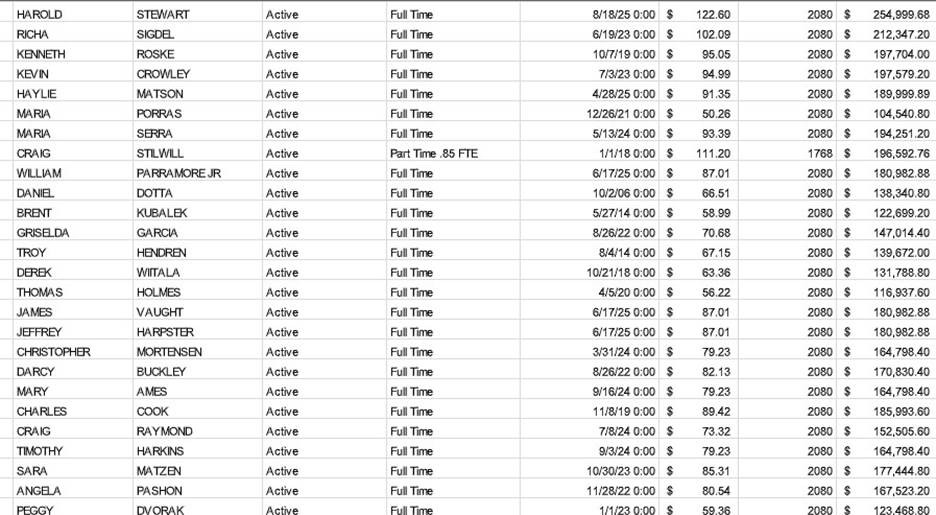
- The City Manager alone earns over $250,000
- The Deputy City Manager is paid over $212,000
- Police and Fire Chiefs both approach or exceed $197,000 each
- The Community & Economic Development Director is nearly $190,000+
Total base salary for these Top 5 executives: over $1 million.
Total cost after benefits: likely $1.3–1.5 million.
All while the city warns residents of “hard choices,” “belt-tightening,” and “revenue shortfalls.”
Capital Projects: Cost Overruns & Overcommitments
Beyond payroll, Pasco continues sinking money into:
- Multi-million-dollar capital projects
- Parks and road projects delayed and over budget
- A CIP portfolio that reads like a wish list, not a financial plan
- Projects financed by bonds the city is struggling to support
- Development slowed by rising construction costs
Pasco is spending like a booming metropolis — but collecting revenue like a working-class farm city.
This imbalance is now hitting the wall.
Leo Perales Has Been Warning the Public — And Now the Numbers Prove Him Right

Councilmember Leo Perales has repeatedly flagged:
- Growing deficits
- Staff overbuilding budgets
- Reserves draining too quickly
- A potential utility tax increase
- Unsustainable spending patterns
He even described the proposed tax hike as a “soft no” until the city reins in spending.
And the city’s own payroll data backs up his concerns.
Tax Hikes for the Public — But Raises, Benefits & High Salaries at the Top?
The city is talking about:
- Raising utility taxes
- Cutting programs
- Delaying street maintenance
- Reducing services
- “Restructuring” departments
Meanwhile, the most highly paid executives in City Hall continue to enjoy six-figure salary packages, elite benefits, and the security of PERS. According to Perales, the city staff was just given a 3 percent cost of living adjustment (COLA) even as the city is in a deficit.
Pasco’s working-class Latino families — the backbone of this community — are being asked to pay more and get less.
La Voz’s Position: If Pasco Wants to Fix Its Budget, It Must Start at the Top
Before telling residents to sacrifice, Pasco must:
- Reevaluate executive salaries
- Freeze upper-management raises
- Audit administrative spending
- Control capital project overruns
- Reduce benefit and allowance bloat
- Prioritize services, not bureaucracy
You cannot fix a $10 million deficit by cutting library hours or youth programs — while paying the Top 5 administrators over a million dollars a year before benefits.
Final Word: Pasco Doesn’t Need Higher Taxes — It Needs Better Priorities
La Voz will continue monitoring:
- Payroll structures
- PERS cost impact
- Overruns on capital projects
- Internal spending practices
- Transparency failures
Pasco taxpayers deserve answers — not excuses, not spin, and not more tax hikes.
With over $6.53 million going to management salaries and more than $1 million to just the Top 5 administrators, one thing is clear:
Pasco doesn’t have a revenue crisis.
It has a leadership spending crisis.